Admin@inusaglobal.com
 +6285607714585


Drawings Are Already IFC. Why Are There Still So Many Changes in the Field?
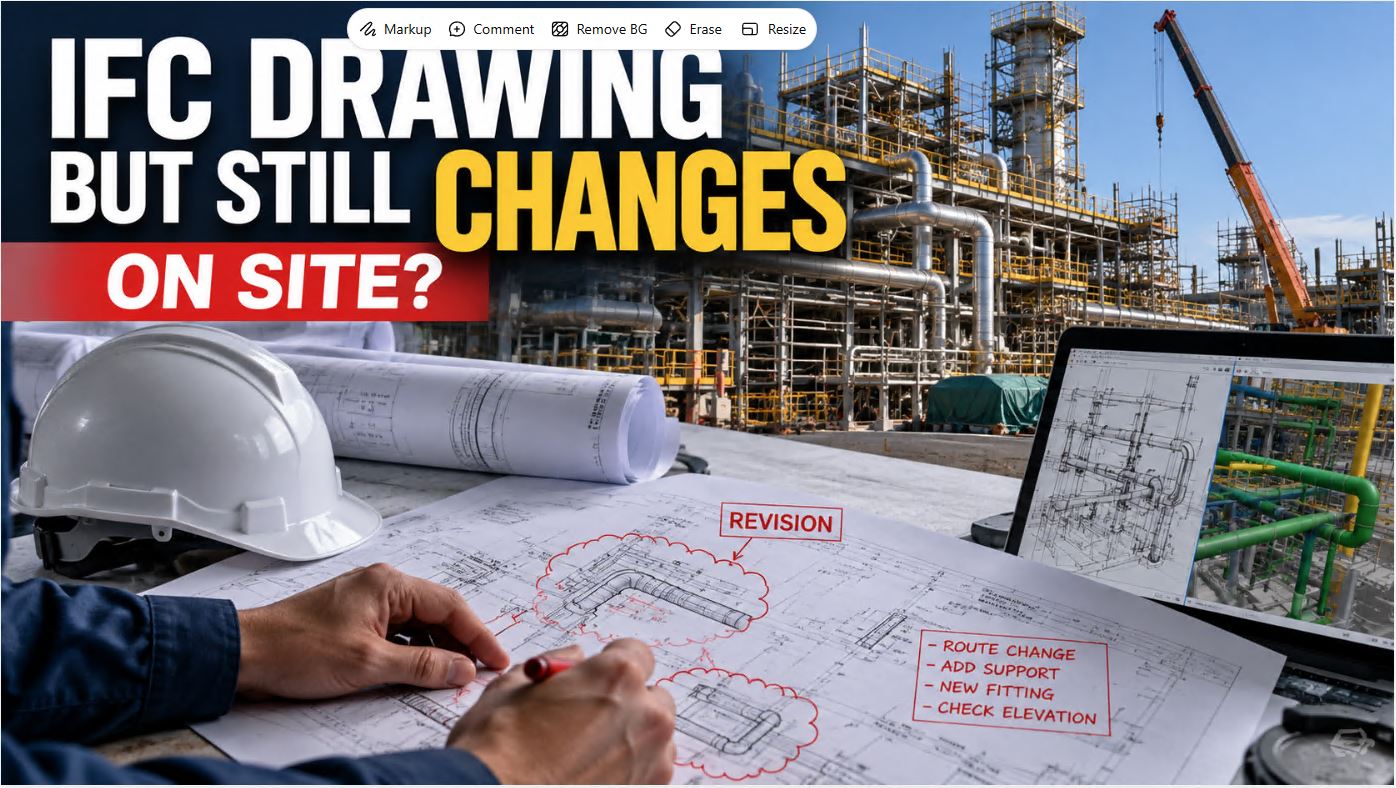
Imagine an EPC Oil & Gas project that has entered the construction stage. Engineering has issued most drawings with the status Issued for Construction (IFC). Materials have been purchased, piping spools are being fabricated, and the construction team has prepared the installation schedule.
However, when work begins in the field, problems start to appear.
The pipe support position clashes with the steel structure. The piping route does not leave enough space for equipment maintenance. The nozzle orientation does not match actual field conditions. Some piping routes even have to change because of differences between the drawings and the existing facility.
As a result, work that should have proceeded directly has to stop temporarily while engineering issues are resolved.
But the drawings are already IFC. So what really happened?
1. IFC Does Not Mean Free from Change
IFC indicates that a drawing has gone through the review and approval needed to be used as a construction reference. However, it does not mean that all field conditions can be confirmed at the engineering stage.
Some issues only become visible when the work is actually carried out, especially on brownfield projects, tie-in work, or areas with many cross-discipline interfaces.
The problem is not simply that drawings are revised, but how those changes are identified, controlled, and resolved without causing a bigger impact on the project.
IMPORTANT
IFC status does not guarantee the design will not change. Every revision must be controlled so that the construction team always uses the latest approved drawing.
2. The Importance of Constructability Review
Constructability review should ideally be carried out from the engineering stage, involving the construction team, engineering, and related disciplines.
A review should not only confirm that the design meets technical requirements. The design must also consider the following aspects:
- How equipment will be lifted and installed in the field.
- How piping spools are fabricated and installed.
- Available space for welding, inspection, and hydrotest.
- Access for maintenance once the facility is operating.
- Coordination between piping, mechanical, civil, electrical, and instrumentation.
- Whether the design matches the actual condition of the existing facility.
The more problems found before IFC is issued, the fewer changes have to be resolved during construction.
KEY POINT
An effective constructability review not only checks whether the design can be built but also considers safety, work access, installation sequence, material needs, and ease of maintenance.
3. When Problems Are Found in the Field
For example, the construction team finds that a piping route on an IFC isometric drawing clashes with an installed structure.
A Field Engineer should not change the routing on their own decision. The problem must be documented through a Site Technical Query (STQ) or the technical query procedure applicable to the project.
The engineering team then evaluates alternative solutions, including their impact on pipe stress, supports, maintenance access, materials, and interfaces with other disciplines.
After the solution is approved according to project procedure, the drawing can be revised and distributed to the relevant teams.
Field Change Control Flow
Illustrative flow. Approval and change control processes follow each project's procedures.
IMPORTANT
Do not modify the design in the field without approval from the authorized engineer. Make sure drawing revisions, material changes, and execution instructions have been approved according to project procedure.
4. One Isometric Revision Can Affect Many Work Items
A routing change that looks simple on a drawing is not necessarily simple to carry out.
An isometric revision can lead to changes in pipe length, additional fittings, changes to pipe supports, cancellation of fabricated spools, and the need to buy additional materials.
If those materials are not available in the warehouse, procurement must make a new purchase. The fabrication schedule may need adjusting, while the construction team must rearrange the workfront and installation sequence.
If the line belongs to a system scheduled for hydrotest or mechanical completion soon, the delay may also affect commissioning readiness.
One design change can trigger changes in materials, cost, and schedule.
Example Impact of an Isometric Revision
| Aspect | Potential Impact |
|---|---|
| Engineering | Isometric revision, pipe stress analysis, and pipe supports. |
| Procurement | Additional materials, MTO changes, and the need for new purchases. |
| Fabrication | Spool modification, additional welding, NDT, or rework. |
| Construction | Changes in workfront, installation sequence, and manpower needs. |
| Planning | Schedule adjustments, activity changes, and potential delays. |
| Commissioning | Potential changes to the hydrotest, mechanical completion, and system handover schedule. |
5. What Should a Project Engineer Watch For?
A Project Engineer should not only monitor how many drawings have been issued or what percentage of construction work is complete.
A Project Engineer also needs to understand:
- The status of technical queries and outstanding engineering.
- Drawing revisions and the distribution of the latest revisions to the field.
- Material readiness based on the latest drawings.
- The impact of changes on the fabrication and construction schedule.
- Potential rework and additional costs.
- The impact on mechanical completion and commissioning readiness.
In addition, every change that may affect cost or time must be evaluated against the scope of work, the contract, and the applicable change management procedure.
KEY TAKEAWAY
Engineering success is not only about issuing drawings on time, but also about producing a design that can be built safely and efficiently and that meets operational needs.
What About Your Experience?
On the EPC projects you have handled, what most often causes IFC drawing revisions during construction? A lack of constructability review, changing field conditions, or cross-discipline coordination?
Feel free to share your experience and views.
Improve Your EPC Project Competence
For fresh graduates and project teams who want to broaden their understanding of how Engineering, Procurement, Construction, and Commissioning relate on Oil & Gas projects, explore the EPC Construction program at INUSA Global.
View the EPC Construction Program →
www.inusaglobal.com