Admin@inusaglobal.com
 +6285607714585


𝗦𝗰𝗵𝗲𝗱𝘂𝗹𝗲 𝟵𝟬%, 𝗯𝘂𝘁 𝘄𝗵𝘆 𝗶𝘀 𝘁𝗵𝗲 𝗽𝗿𝗼𝗷𝗲𝗰𝘁 𝗻𝗼𝘁 𝗿𝗲𝗮𝗱𝘆 𝗳𝗼𝗿 𝗖𝗼𝗺𝗺𝗶𝘀𝘀𝗶𝗼𝗻𝗶𝗻𝗴?
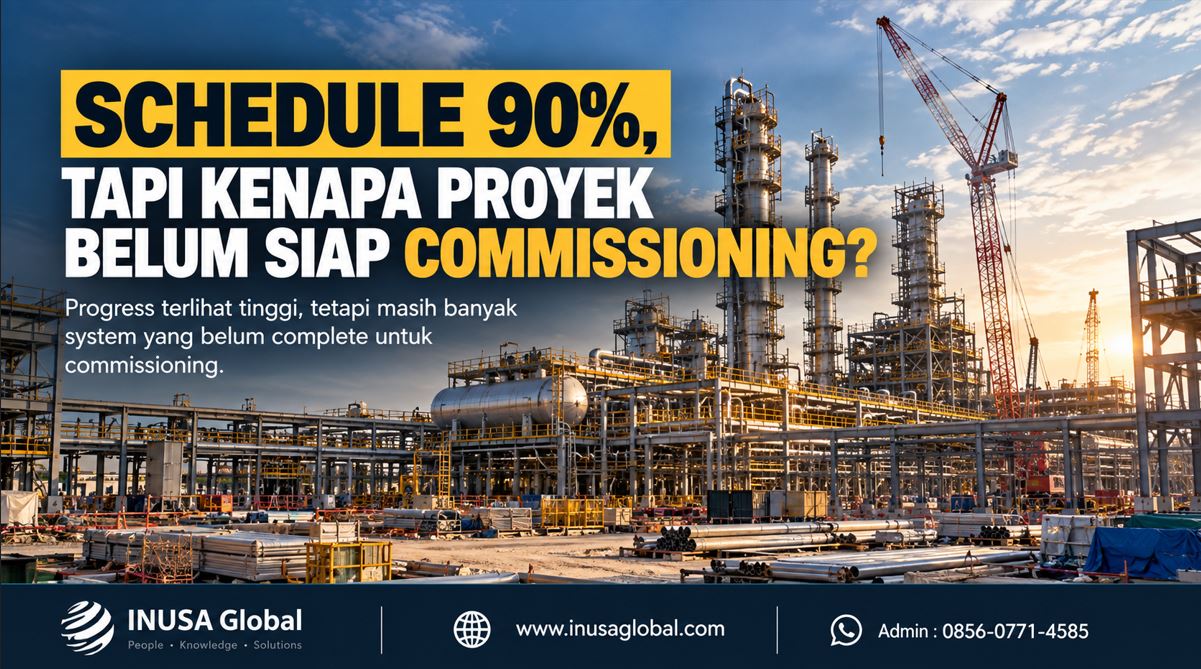
The schedule already shows 90% progress. So why is the project not ready for Commissioning?
This situation is quite possible on EPC Oil & Gas projects.
In a progress report, 90% certainly looks convincing. Engineering is almost finished, most equipment is installed, piping work is nearing completion, and electrical and instrumentation work continues.
Overall, the project seems close to the finish line.
But when readiness starts being checked by system and subsystem, the picture can be different.
Some piping test packages may not be closed. Reinstatement after hydrotest is still in progress. Some punch items still affect operability. Motors are installed but not energized. Instruments are installed but loop checks are not complete. Even the utilities needed to run commissioning may not be available.
In other words, high physical progress does not necessarily mean commissioning readiness.
At the construction stage, progress is mostly calculated by quantity: how many tons of structure are erected, how many meters of piping are installed, how much equipment is in place, or how many meters of cable have been pulled.
But the closer a project gets to commissioning, the more the question changes.
Not only:
“What percentage of the work is finished?”
But also:
“Which systems are truly ready to hand over to Commissioning?”
Imagine a pump system.
The pump is installed. Suction and discharge piping are finished. Cables are pulled, and visually the work looks almost complete.
But the pump is not necessarily ready for commissioning.
Alignment may not be accepted. The motor is not energized. Lubrication is not complete. Piping reinstatement is not finished. Instrument loop checks are not finished. Or the suction system needed to run the pump is not available.
One critical outstanding item can keep a system from being ready for the next stage.
That is why, as construction nears its end, the way progress is viewed must also start to shift:
Area Completion → System Completion
Quantity Installed → System Ready
Then it continues through the stages:
Construction → Mechanical Completion → Pre-Commissioning → Commissioning → Start-Up → Handover
This is why it is important for the Project Engineer, Construction Engineer, Planner/Project Control, QA/QC, and Commissioning Engineer to understand how work relates across disciplines.
Because the success of an EPC project is not only about finishing the work of each discipline.
The ultimate goal is to produce a facility that is complete, safe, tested, commissioned, ready for start-up, and ready to hand over to Operations.
So when a progress report shows:
PROJECT PROGRESS: 90%
There may be an equally important question:
“How many systems and subsystems are truly ready for commissioning?”
What about your experience on your projects?
As completion approaches, is progress still viewed mostly in terms of physical progress, or has the focus started to shift to system completion and commissioning readiness?
For fresh graduates and project teams who want to understand how Engineering, Procurement, Construction, Pre-Commissioning, and Commissioning connect in an EPC Project, explore the competency development programs at:
INUSA Global
www.inusaglobal.com
#EPC #OilAndGas #Commissioning #Construction #ProjectEngineering #ProjectControl #MechanicalCompletion #PreCommissioning #ProjectManagement #INUSAGlobal